AI / Artist-Centric: Deezer champions a European model for streaming
With the meteoric rise of artificial intelligence, the music industry finds itself at a new turning point in its history. Every day, Deezer sees a flood of nearly 10,000 new AI-generated tracks, accounting for nearly 10 per cent of its catalogue. This figure is constantly rising, raising the question: what are we playing to listeners, and how can we fairly remunerate artists who feel short-changed by this deluge of AI-generated content?
- Written by Louise Blas

For Aurélien Hérault, Chief Innovation Officer at Deezer, the answer cannot be left to chance. Catalogue saturation, low-quality content, stream fraud, environmental impact, and remuneration for ‘real artists’: these are just some of the issues raised by this phenomenon. And to tackle them, the platform has decided to take action!
AI: between creative potential and a threat to the industry
Whilst AI can be seen as just one of many tools artists can use to bring their projects to life, it can become a real problem when it is misused for the purposes of mass, automated production. Tracks with no identifiable human creator, duplicate titles, ‘fake artists’, and fraudulent behaviour fuelled by tools designed to optimise recommendation systems: this phenomenon has a very real impact on the visibility and remuneration of ‘authentic’ artists. In response to this proliferation of AI-generated content, Deezer is pursuing a clear and straightforward strategy: to identify, regulate and raise awareness.

Aurélien Hérault, Head of Innovation at Deezer
Since December 2024, Deezer has rolled out an in-house AI content detection system. The result of a year and a half of research, this system is capable of detecting artefacts that are inaudible to the human ear but perfectly identifiable by machines. Once a track has been identified, it is tagged as AI. It remains available to listen to, but is excluded from recommendation systems.
With an accuracy rate of 99.8 per cent for the most popular models, the platform is focusing its efforts on the most widespread uses, without seeking to demonise AI: it is the abuses that the platform is combating, not the use of AI itself. As Aurélien Hérault points out, the technology is already integrated into many of the tools used by musicians and producers.
Research, transparency and the consortium
For Deezer, the fight against AI-generated content and attempts at manipulation also involves R&D. Its in-house research laboratory has, in fact, been working on this topic for over ten years using machine learning, regularly files patents, and is even considering sharing some of its technologies with other players. The French platform was also the first to sign the Global Declaration on AI Training, advocating for a more transparent opt-in/opt-out model.
Furthermore, in the face of American and Chinese giants, Deezer is drawing on European excellence with partners such as Kyutai, and is campaigning for the establishment of an international consortium. Without a common framework, it is indeed difficult to ensure that sound principles are upheld.
“It’s important to realise that we have a very strong community of researchers and scientists in France and across Europe, and many of them are also based in China and the United States. We must capitalise on this fabulous opportunity, being able to choose all the elements and tools to define what we, as French people and as Europeans, want to do with technology – its use, its development, its regulation… We have a choice, and I think it’s good that French and European players are speaking out and saying: we want to build a model that is our own.”
Aurélien Hérault, Head of Innovation at Deezer
Artist-centric: a fairer revenue-sharing model
Used by the majority of the industry, the market-centric model is based on distributing revenue generated in proportion to the total volume of streams. Particularly favourable to the huge streaming giants, this model penalises ‘smaller’ artists who account for a tiny fraction of total streams. More equitable and intended to reflect what users actually listen to, the user-centric model, however, remains a pipe dream that is struggling to gain traction, due to its technical complexity and the difficulty of reaching a consensus amongst industry stakeholders. At the crossroads between these two remuneration systems, Deezer and Universal Music Group have forged a middle ground by introducing the artist-centric model in late 2023!
In practical terms, the model now championed by the French music streaming giant redirects revenue to professional artists, identified by activity criteria: at least 1,000 plays by 500 unique monthly users. These same artists benefit from a double boost in visibility. This is one of several measures used by Deezer to make manipulation strategies less profitable.
Artists’ remuneration at the heart of the debate
Music streaming platforms are usually very secretive about how they remunerate rights holders, with each having negotiated on its own behalf. Deezer’s commitment to transparency is a first. Shortly after these announcements, Qobuz, another French platform, made a strong impression by revealing its payout rate per stream, which is five times higher than the average.
To put this into perspective, if a track reaches 1,000 plays on Qobuz, it generates $18.73 for rights holders, who then pay the artists, songwriters and composers in accordance with their contractual agreements. This transparency is to be commended in an industry that is often sorely lacking in it.
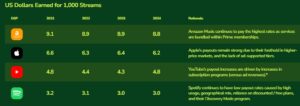
Duetti’s estimates for 2024
It is the first company to officially publish its royalty rate, although estimates are regularly calculated. Duetti had put forward an estimate at the end of 2024 which certainly caused a stir.
user-centric model, superfans… other revenue models for artists
For Aurélien Hérault, the artist-centric model is a first step in the paradigm shift being pursued by Deezer. The user-centric model focuses on the individual behaviour of platform users. The recent development of the ‘superfan’ segment – the new El Dorado for players in the music industry – is, moreover, another significant milestone in this long process towards a fairer model for artists and users.
And the record labels are well aware of this! In 2024, Robert Kyncl, CEO of Warner, stated:
“Artists and superfans want deeper relationships: this is a relatively untapped and under-monetised area.”
Robert Kyncl, CEO of Warner
For the industry and for artists, engaging with (super)fans may well seem like a land of opportunity. And a different business model that relegates streaming platforms to the back seat.
Whilst waiting for disruptive players to emerge, Deezer continues to innovate to balance technology with respect for artists, testing 70 recommendation systems every year.
AI is here to stay, but it could be better regulated. However, this requires everyone to be on the same page. And this is perhaps one of the platform’s greatest challenges: managing to get all industry players to agree on a single model!
Rather than embarking on a witch-hunt with a highly uncertain outcome, Deezer has chosen to regulate the use of this indispensable technology and to restore value to real-life artists. By focusing on transparency and promoting new methods of revenue sharing, the French platform hopes to inspire other players in the music sector – and perhaps even beyond. It’s a bold move, but undoubtedly necessary to ensure that human creativity continues to resonate through our speakers and headphones for a long time to come!
The PIX festival brings together the cultural and creative industries ecosystem
Aurélien Hérault was invited in April 2025 to take part in the PIX festival organised by Plaine Images. PIX was born out of a desire to showcase key players in the cultural and creative industries of the Hauts-de-France region.
As well as being an opportunity for networking amongst those working in the creative industries, PIX also serves as a source of inspiration for professionals from ‘elsewhere’ looking to draw on the good ideas, methodologies, creativity and innovations produced within the cultural and creative industries.
Watch the full recording of the talk here:
And to watch more talks, visit our YouTube channel.